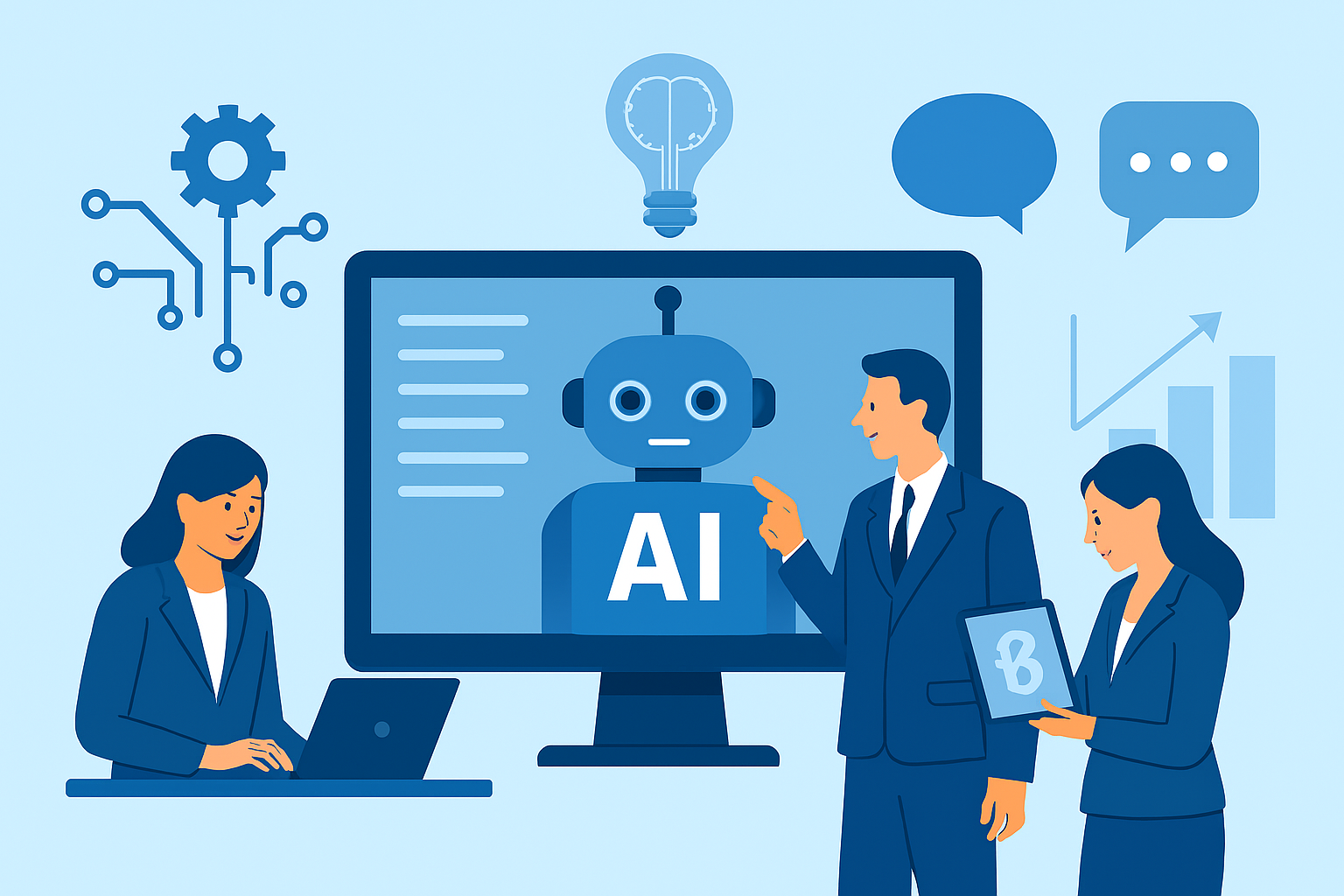
There's a certain fatigue that comes with being told AI will change everything. For most business owners, the practical question isn't whether AI is significant — it's whether any of it is actually useful right now, in the specific context of how their business operates.
This article isn't about the future of AI. It's about the present: what it can reasonably do today, where it tends to help, and what it's still not well-suited for.
What "AI in business" actually means
When we talk about AI in a business context, we're rarely talking about autonomous systems making strategic decisions. In most small and medium-sized businesses, AI currently means one of several things:
- Language models that can draft, summarise, and respond to written content
- Automation tools that trigger actions based on rules or patterns in data
- Classification and routing systems that sort incoming requests, emails, or documents
- Conversational assistants that handle frequently asked questions or initial customer contact
Each of these has a real place in business operations — but that place isn't universal. Context matters enormously.
Where AI tends to provide genuine value
1. Handling high volumes of routine written tasks
If your team spends a significant portion of their week writing similar emails, responding to common enquiries, or producing templated reports, AI-assisted writing tools can meaningfully reduce that burden. This isn't about replacing the person — it's about reducing the time they spend on low-complexity, repetitive content.
A logistics company we worked with had a customer service team fielding 150–200 emails per day. Around 60% of those were variations of the same five questions about delivery windows, delays, and returns. An AI assistant handling the initial response and flagging the rest for human review cut first-response times from several hours to under a minute, while freeing staff to focus on more complex cases.
2. Summarising and extracting information from documents
Many businesses accumulate large amounts of internal documentation, contracts, policies, or research that nobody has time to read thoroughly. AI tools are now reasonably capable of summarising documents, extracting key points, and answering questions about their content.
This has practical value for onboarding new staff, reviewing supplier contracts, or consolidating information from multiple sources. The caveat: these tools can misread nuance or miss context-specific implications. They work best when paired with human review rather than used as standalone decision-makers.
3. Automating structured, rule-based workflows
If a process follows a consistent pattern — collect data, check against criteria, trigger an action — it can often be automated effectively. Invoice processing, appointment scheduling, stock alerts, and report distribution are all examples where automation can reduce manual effort substantially.
The key word is "structured." Processes that require judgement, negotiation, or flexibility in how decisions are made are harder to automate reliably. Starting with the most predictable parts of a workflow tends to produce better results than trying to automate the whole thing at once.
4. Supporting data organisation and retrieval
Businesses often have useful information locked in formats that make it hard to find or use — emails, PDFs, spreadsheets, or legacy systems. AI tools can help categorise, tag, and surface that information more effectively. For knowledge-intensive businesses, this can have a meaningful impact on how quickly staff find what they need.
Where AI still has real limitations
Equally important is understanding where current AI tools are not ready for unsupervised use in business contexts.
Complex judgement calls. AI can summarise options and surface relevant information, but it lacks the situational awareness to make sound judgements in complex or ambiguous situations. Contract negotiations, sensitive client conversations, and strategic decisions still require human judgement.
Accuracy with facts and figures. Language models in particular can generate plausible-sounding but incorrect information, especially when asked to recall specific data, regulations, or statistics. Any AI-generated content that involves factual claims needs verification before it goes out or is acted on.
Highly variable or creative processes. Tasks that require genuine creativity, deep contextual understanding, or the kind of interpersonal sensitivity that makes a difference in relationships tend not to respond well to automation. This isn't a temporary limitation — it reflects something about the nature of those activities.
Anything touching sensitive personal data without appropriate safeguards. Using AI tools that send data to third-party servers requires careful consideration of your data protection obligations. Not every tool is appropriate for processing client information, employee records, or sensitive business data.
A practical starting point
For most businesses, the most useful approach is to start small: identify one or two processes where there's a clear volume problem or a well-defined pattern, test a tool in a controlled way, and evaluate honestly whether it's delivering value.
Avoid the temptation to overhaul everything at once. The businesses that get the most from AI are usually those that introduce it gradually, build familiarity among their team, and iterate based on what they learn.
If you're unsure where to start, or whether any of this applies to your specific situation, a straightforward conversation with someone who can look at how your business actually operates is usually more useful than any amount of general reading. We're happy to do that — without obligation.
About Mye Tech
We help UK small and medium-sized businesses understand, evaluate, and implement AI tools in ways that fit how they actually work. If you found this useful, you might also want to explore our other articles or speak to the team directly.
Get in touch